
What exactly is Chinese foot binding?
Well, most people assume that foot binding is when a young Chinese girl's foot is bound by bandages to stop the foot from growing. This is partly true, except there are a lot more grotesque details involved.
First off, multiple accounts attempting to explain the origin of foot binding exist, the most common one from the desire to emulate an empress who had club-like feet, which became viewed as a desirable fashion.
Women of the time also believe that small feet like the empress meant that it was the only way she could marry a man because men looked for women with small feet Men never actually saw the foot beneath the shoes and it was said, through many diaries of the time, that this was sexually appealing to them to not know what women's feet looked like. Men would first choose a wife by seeing if she
 had 'clown feet' or small moon-shaped feet. The perfect feet were about three to three and a half inches in length which was referred to as the 'golden lotus'.
Also, foot-bound wife meant that she could not walk long distances. So, she had no choice but to stay around the house, therefore being completely devoted to her husband.
Chinese foot binding was practiced for 1,000 years beginning around the 10th Century and finally ending in the 20th Century.
Actually, some elderly Chinese women can still be found with bound feet from when it was done to them as young girls.
What is the actual process of Chinese foot binding?
The process of foot binding was quite excruciating. It was usually performed on a young girl between the ages of three and 10 before the bones in the foot were fully developed. Also, binding usually started during the Winter months so the pain would not be as bad because the feet were already numb from the cold.
First, the girl's foot was soaked in a mixture that consisted of herbs and animal blood. This concoction would soften the foot to aid in binding. The toenails had to be cut back as far as possible in order to prevent the nails from growing into the foot which would cause infection. The girl's feet are then massaged to prepare the child for what was to follow.
Cotton bandages that are 10 feet long and two inches wide are then soaked in the same herb and animal blood mixture. The toes on each foot would then be pressed down to the bottom of the foot until each toe was broken. The cotton bandage would hold the toes there until the process was to be repeated the following day for richer families, and a few times a week for poorer families.
The bandage was wrapped in a figure eight movement pulling the toes closer to the heal in turn breaking the arch of the foot. Overtime, this would cause a two inch groove in the foot as shown in the photo:
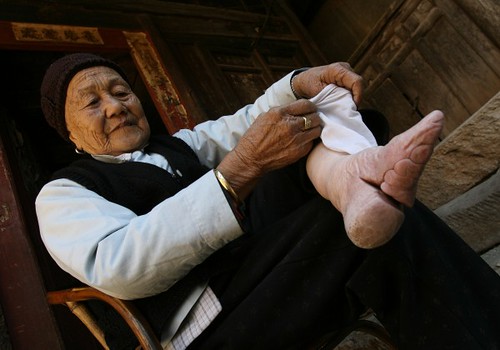
Once the binding was completed, the bandage was sewn together so that the girl would not try to loosen it. The herbs and animal blood on the bandage would dry up causing the bandages to shrink which pulled the toes closer to the sole. Also, the girl was not allowed to rest and had to walk long distances after the binding in order to further use her body weight to break the foot.
Each time the foot has to be rebound, the foot is soaked in a 'special potion' that causes any dead or dying flesh to fall off. Then, the binding is performed as before.
Special shoes were required for the small-footed girls. They were called 'lotus shoes' (which can be seen on the elderly woman in the first photograph) because of the way the foot was shaped. The feet of the girls, once the process was completed, were shaped like a lotus flower.
What about the long-term effects of Chinese foot binding?
Foot binding causes gangrene on the feet from the in-grown toenails. Also, from women having to walk to lightly in their old age, they tend to fall more often causing a broken hip or possibly another bone. Many elderly women today regret the fact that they had their feet bound. One women was quoted wishing that she had not had 'lotus feet' throughout her life so she could dance.
Fortunately, Chinese foot binding was banned in 1912 and all Women were ordered to unwrap their feet. Failure to do so resulted in heavy fines and in some cases, death. When the Communists came into power in 1949, they too ordered a nation wide ban on foot binding. This was especially devastating to women with bound feet because most of them were forced to perform hard physical labor in the 1950’s.
Chinese foot binding was considered the most beautiful part of a women's body for 1,000 years. The saying, 'beauty is pain', would in fact, be correct in the history of the Chinese culture.


Gross, weird and wonderful.
ReplyDeleteNow call back...